Showing posts with label Planning. Show all posts
Showing posts with label Planning. Show all posts
Tuesday, 16 December 2014
Alterations, Technical Difficulties and Story Board Changes
Above, some of our alterations and changes explained.
Friday, 12 December 2014
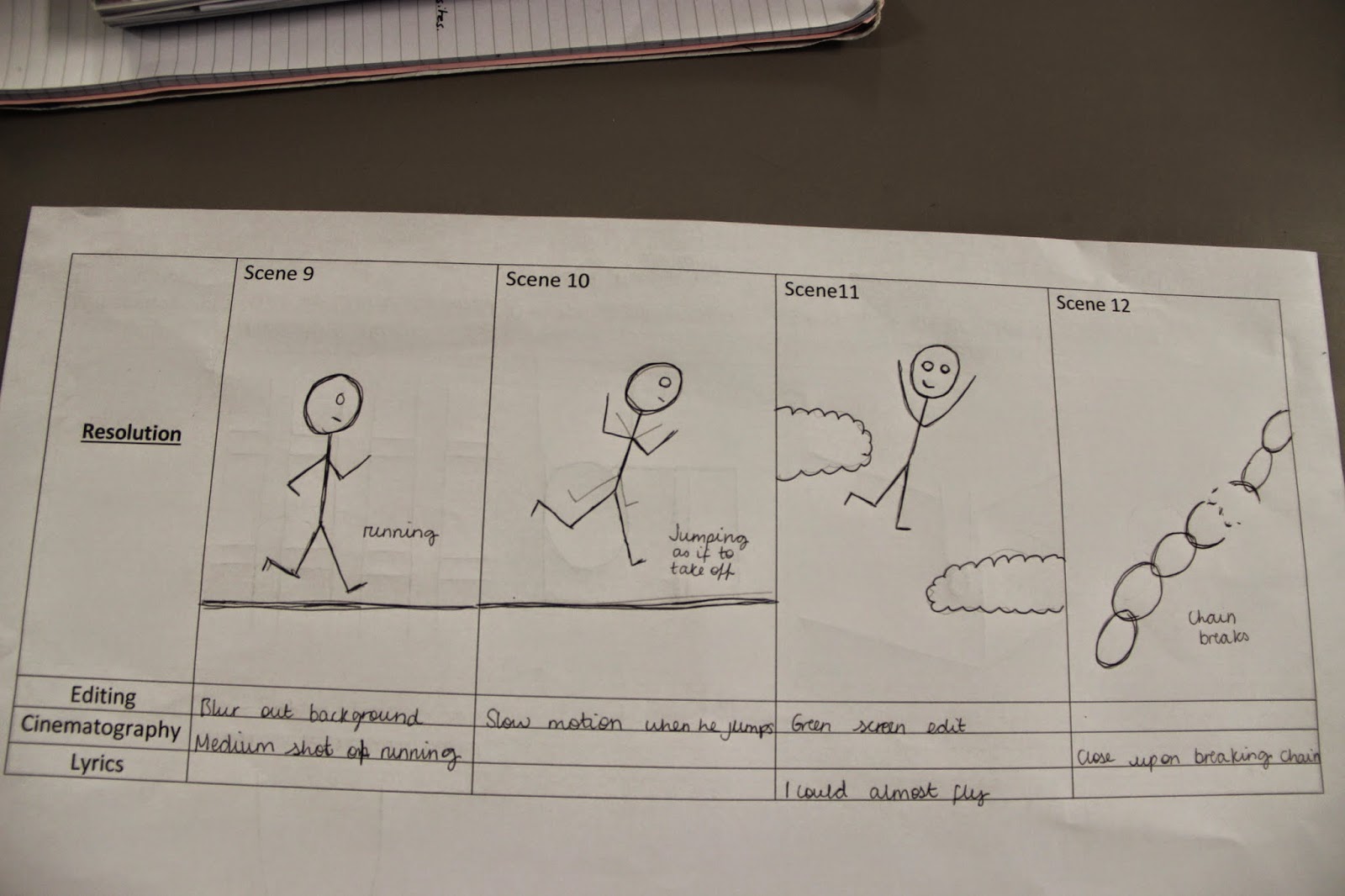
Work is progress photographs of our story boards

These story boards show our ideas so far, we have listen to the song (Across the Skyline) and taken inspiration from the lyrics and mood of the music. Some of our ideas have been symbolic and some have been literal representations of the lyrics.

We have chosen to include narrative and performance in our video; peer feedback and research has shown us that this mix of music video genres is commonly used by Indie-Rock bands and artists.
Thursday, 11 December 2014
Thursday, 4 December 2014
Initial title ideas
We have used Wordle to create a representation of our initial ideas for the title of our album.

This is a Wordle of our title ideas.

This is a Wordle of the key terms and phrases associated with our song.
This is a Wordle of our title ideas.
This is a Wordle of the key terms and phrases associated with our song.
Thursday, 27 November 2014
Health & Safety

Above: our set of health and safety considerations. It includes our filming locations, issues that may appear in each location and how to deal with the issues.
Saturday, 22 November 2014
Peer feedback of rough cuts

This feedback sheet shows that we have met most of the criteria to a satisfactory standard. They feel that we have produce very steady shots but we need to increase the binary opposites in our video. We will do this by increasing the amount of narrative in our video so that we can continue our use of binary opposites.
 This feedback shows that we have performed strongly in a majority of the criteria including variety of shot types used, variety of angles used and inclusion of binary opposites. But we didn't perform as highly in our use of a variety of shot movement, framing and semiotics. We will improve in these areas by using more camera movement during the performance sections of our video, taking more time to check the framing of each shot and think about how to include more semiotics.
This feedback shows that we have performed well in some criteria; steady shots, variety of shot angles and framing, But we have not performed as well in the other criteria including variety of shot type and variety of shot movements. We can improve these scores by, like above, increasing shot variety and movement.

This feedback shows we have performed well in the top 4 criteria, including shot type and movement. But we need to improve the framing in our shots, semiotics and binary opposites. We can do this by, like above, taking time to checking the framing of our shots, including more semiotics and binary opposites.

This feedback shows that we have performed well in all of the criteria and very well in one criteria- our variety of shots. This shows that so far we have created a varied and interesting video.

This feedback shows that we have performed well in a majority of the criteria including steady shots, shot variety and framing. But there is room for improvement in the shot movement, we can do this by using more movement. We also need to improve on our use of semiotics and binary opposites, we can do more research and planning into these criteria to find inspiration.


This feedback shows that we have performed well in two criteria, steady shots and framing. But we need to improve on the other criteria including variety of shot type and shot movement. We can do this by trying out different and interesting shot types and movements.

This feedback shows that we have performed well well with our variety of shot type and angles.
We could do work to improve the shot steadiness by increasing our use of the tripod. We have performed less well in the other criteria including shot movements and framing. We can improve in these criteria by increasing our use of movement but ensuring that the shot is steady and we should take time to check the framing of each shot.

This feedback shows that we performed well in just over half of the criteria including shot angles and movement. But we need to improve our framing, semiotics and binary opposites. We can do this by checking the framing of each shot, increasing semiotics used and adding more binary opposites.

This group feedback board shows that our peers felt that we used a good variety of shots, had good content, had a good balance between narrative and performance and high quality editing technique.

This group feedback shows what our peers feel needs to be improved. They felt that we needed more footage that's linked by a running theme, more binary opposites needed, develop narrative further, speed up some narrative shots, move boxes from behind curtain in performance shots (framing) and use more close ups.
Friday, 21 November 2014
Locations

Narrative:
Cars and people in the town center, we will use footage shot in town during the narrative parts of our video to display the setting our artist is in.

Narrative:
House, this is the first location in the video. It shows where the artist starts his journey.

Narrative:
High street, this town location contributes to the themes and narrative in the video.

Narrative:
Merrow Downs, this remote location emphasis themes and narrative in our video.

Performance:
Drama Studio, this location suites the performance parts of our video. We can use spot light to create an intimate feel to the shots.
Sunday, 9 November 2014

Friday, 7 November 2014
Sunday, 26 October 2014
Props list
Shoes: the dark coloured shoes will draw the audiences attention to the artists feet, especially when his feet are seen running or walking. This represents his journey, and longing to escape.
 Music player: This will be used at the begining of the video to show the artist pressing play to start the music. This will create a direct link between the music and visuals and this follows Goodwin's rules.
 Instruments: We will be using a four piece band to be in keeping with the song. We will use a microphone, Electric Guitar, Bass Guitar and Drum kit.


Costume, make-up and hair planning
Costume:
The costume worn by our artists (Matt 1) during the narrative parts of our music video will be dark colours, heavy material and layers. He will wear a zipped up dark jacket and dark trousers- this represents his isolation and entrapment.


The costume worn by our artists (Matt 1) during the narrative parts of our music video will be dark colours, heavy material and layers. He will wear a zipped up dark jacket and dark trousers- this represents his isolation and entrapment.
Matt 2 (free Matt) will wear white/light clothes to represent his freedom.
Make-up and hair:
Because our artist is male, we will not be using fashion make up or extravagant hair styles. We may experiment with using make-up to make Matt 1 look pale/ill when he is isolated and tormented by his mind; where as Matt 2 will not wear make-up because he will look healthy and strong because he is free. We would not use as much make-up as the image below, but it is a idea that we can work from.
Wednesday, 15 October 2014
Deconstruction of Lyrics

Using wordle allowed us to identify the key words in the lyrics, this enables us to know what ideas and concepts to focus on when creating our music videos. For example, the words 'disorder', 'feel' and 'pain' show that the lyrics are very personal and meaningful which means we will need to show that in our music video for it to be successful. We could do so by using close-ups on the artist to show his emotions as well as lip syncing, we could also film and edit in such a way that the idea of pain and disorder is illustrated (e.g desaturated to show pain, fast paced or disoriented shots to convey disorder). The words 'window' and 'world' inspire the idea to use windows and reflections. 'World' could also suggest just the artist's normal life and routine, so perhaps shots of towns and people going about their routines could work well. 'Dust' and 'across' inspire the idea for a shot where the artist stamps on the ground and cause dust to fly across the shot. Another example would be the matching the word 'skyline' with a panning or normal shot of a skyline, or simply including the shot of a skyline in out music video to relate to the lyrics.
Examples of words that appear often are, as can be seen in the wordle; dust, disorder, window, skyline, world, pain, feel, across etc.
Tuesday, 14 October 2014


Saturday, 4 October 2014

Friday, 3 October 2014
Pitch
(Our editing ideas were not included in our filmed pitch due to a technical error, but it is included in the slide share presentation)


Wednesday, 1 October 2014
Blumer and Katz- Uses and Gratifications Theory
Diversion-
The audience may watch our music video to escape for everyday life, they could immerse them selves with in the video and feel free from their daily struggles.
Personal relationships-
They may use out music video to substitute for really social interation. They may feel that the artist is sharing his struggles with them and they may feel comforted by his attempts to break free.
Personal identity-
Because our song focuses on the artists personal struggle, a large majority of our late teens- early 20's will be able to identify with the artists issues.
Surveillance-
This aspect of the theory is not connected with our music video.
The audience may watch our music video to escape for everyday life, they could immerse them selves with in the video and feel free from their daily struggles.
Personal relationships-
They may use out music video to substitute for really social interation. They may feel that the artist is sharing his struggles with them and they may feel comforted by his attempts to break free.
Personal identity-
Because our song focuses on the artists personal struggle, a large majority of our late teens- early 20's will be able to identify with the artists issues.
Surveillance-
This aspect of the theory is not connected with our music video.
Subscribe to:
Posts (Atom)